The subject
About Notre-Dame de Paris
Rising on the Île de la Cité, at the very heart of Paris, Notre-Dame is one of the great achievements of French Gothic architecture — and one of the most drawn buildings in the world.
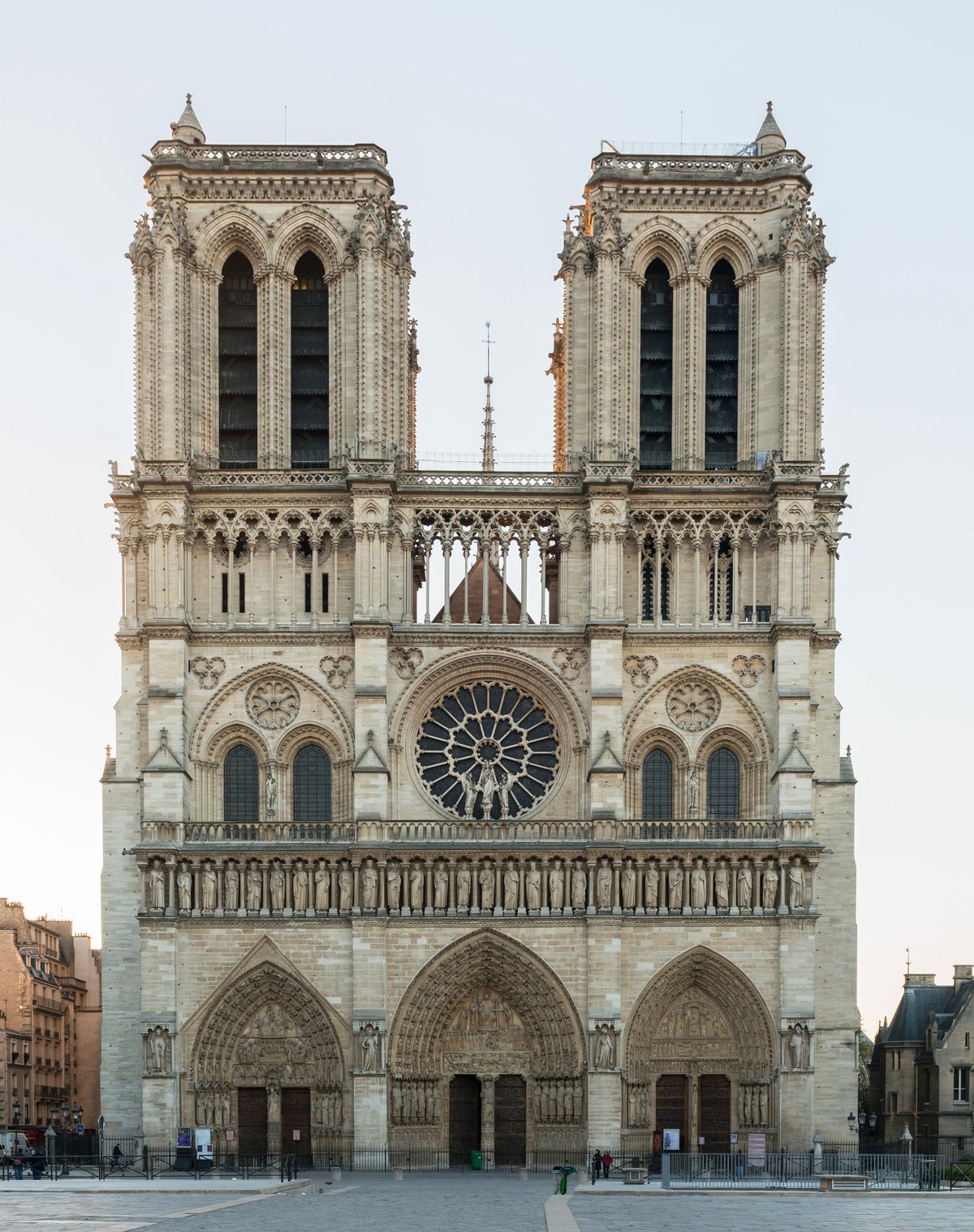
Construction began in 1163 under Bishop Maurice de Sully and continued for nearly two centuries, largely complete by 1345. Notre-Dame was among the first buildings to use the flying buttress on a monumental scale — the external stone arches that catch the outward thrust of the vaults and carry it to the ground, letting the walls rise higher and open into glass.
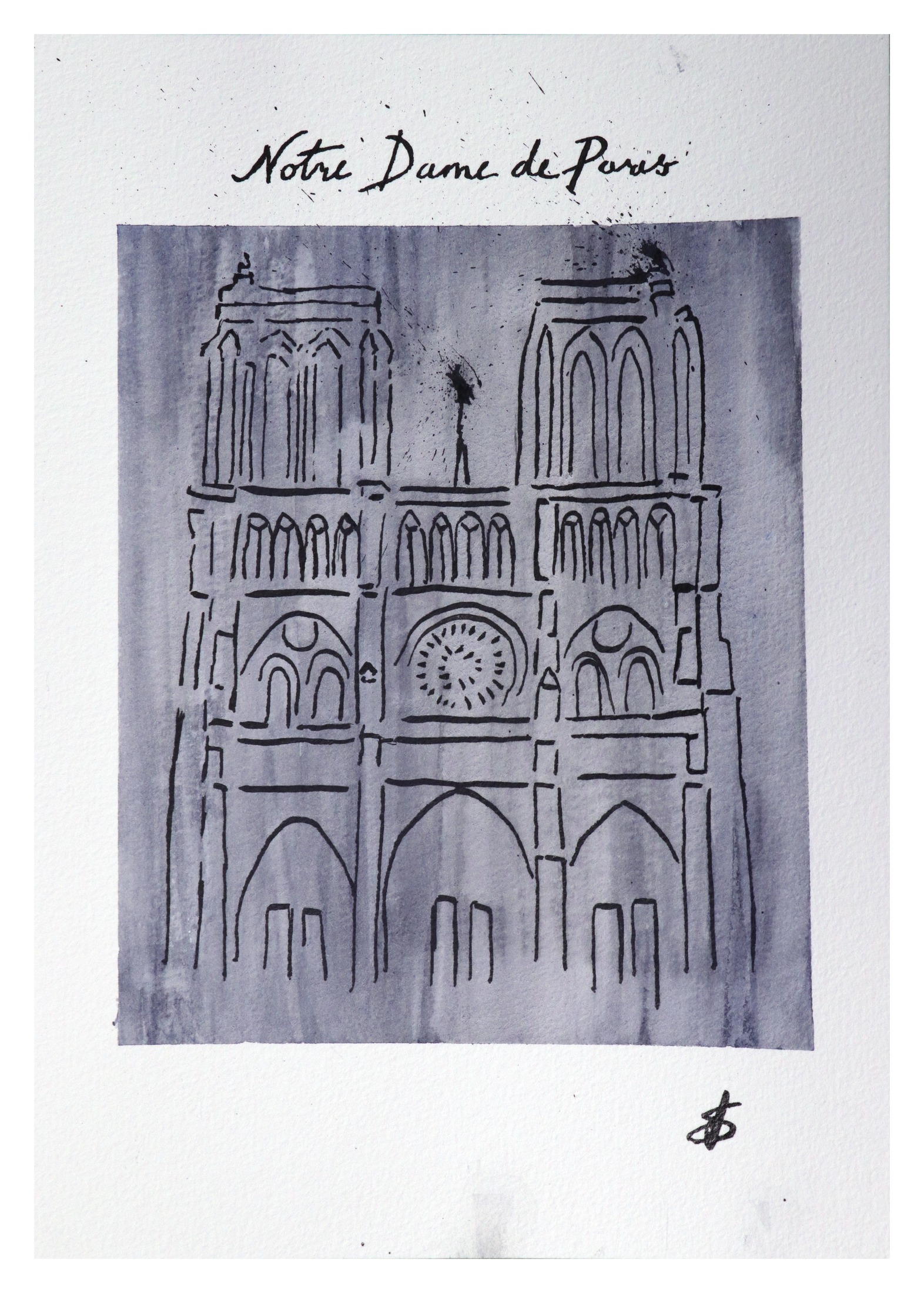
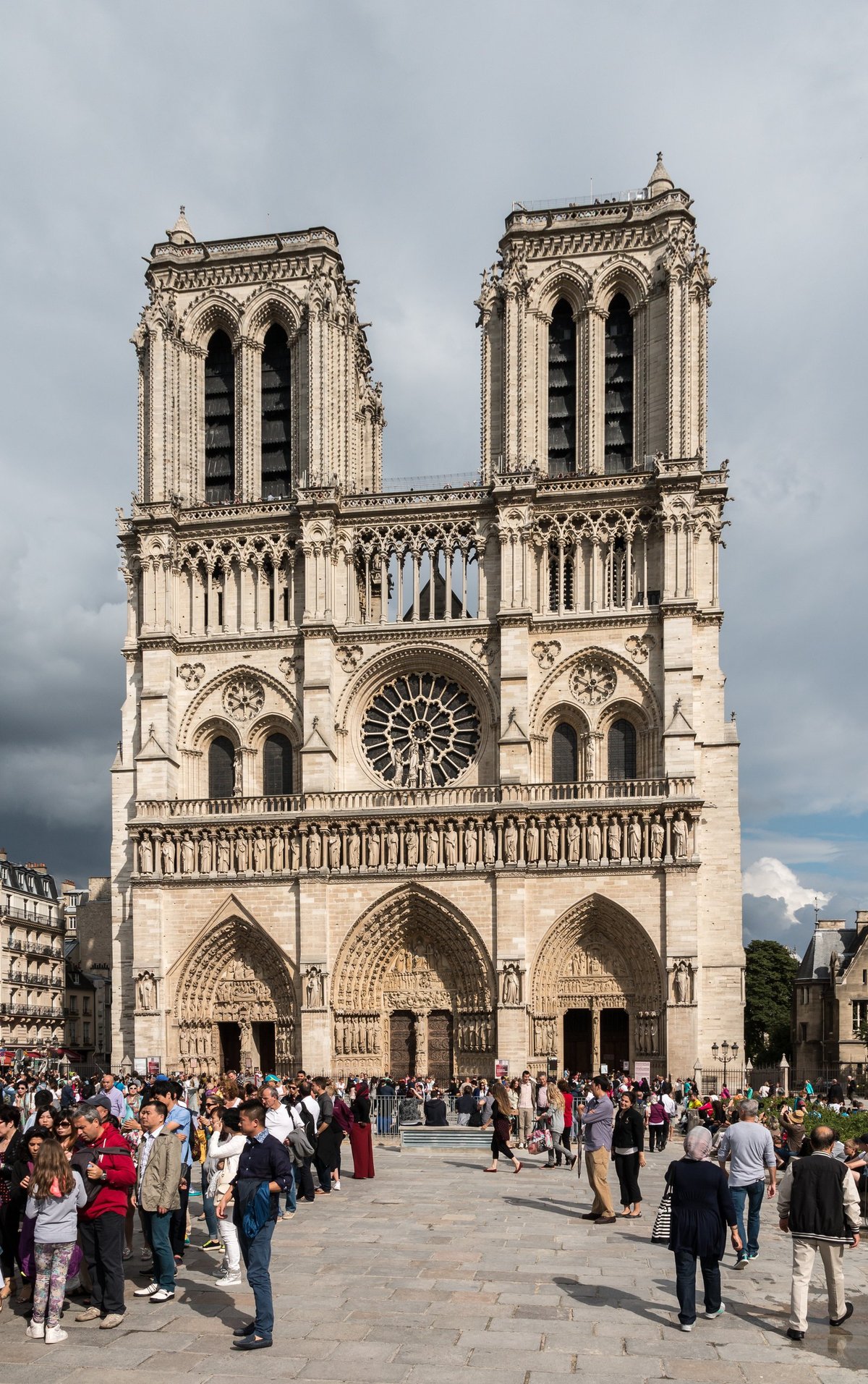
The west front, which I chose to draw, is a study in balance. Three deep portals — the Portal of the Virgin, the Last Judgment, and Saint Anne — anchor the base. Above them runs the Gallery of Kings, twenty-eight figures of the kings of Judah; and at the centre the great west rose window, close to ten metres across. The two square towers rise to sixty-nine metres and, unusually, were never crowned with spires.
The slender central spire and the famous gargoyles and chimeras belong to a later chapter — the nineteenth-century restoration led by Eugène Viollet-le-Duc, who reimagined much of the cathedral’s silhouette. It is that layered history, medieval bones and romantic additions, that gives Notre-Dame its density.
I drew the west front in ink and Payne’s grey alone. Payne’s grey is a cool, deep blue-grey beloved by watercolourists because it reads as shadow without going flat black. In monochrome the drawing can breathe: the deep dark of the portals, the mid-tones of weathered stone, the pale paper left for the light on the towers. It becomes a portrait of structure rather than surface.
Immortalised by Victor Hugo in 1831, the cathedral has drawn artists and pilgrims for centuries. To paint it is to join a very long queue — which is exactly why it is worth trying to see it plainly, in line and shadow, as if for the first time.
On 15 April 2019 a fire tore through the roof and brought down the spire. After more than five years of work by hundreds of craftspeople, Notre-Dame reopened on 7 December 2024 — its stone cleaned, its spire raised once more above the rooftops of Paris.
See also · Payne’s Grey
Château de Chillon ·
Pagoda a Kyoto ·
Mulino di Kinderdijk